COOK IT.
If your butcher didn’t, remove the skin of the pork belly, using a sharp knife. Then, square up the ends so that the belly is a uniform shape. Then, pound the meat to uniform thickness. This will avoid lumps when you roll it.
In a dry pan, gently toast the fennel, mustard, and, if using whole allspice berries, them too. You will know they’re ready when you start to smell them. Use a spice grinder or mortar and pestle to grind the toasted spices coarsely, then add the cure, salt, sugar, and garlic powder.
Generously rub the inside of your pork belly with the cure seasoning mixture, being careful not to get it on the sides and top. You will likely not need all of the cure that you made.
In a small bowl, drizzle some olive oil and add your butcher’s twine lengths. Carefully roll the pork belly so that the cure side is in. In a bowl or shaker, combine the salt, pepper, sugar, onion powder, garlic powder, and paprika.
Using the butcher’s twine, secure the pork belly every inch (2.5 cm). Season the outside and sides of the pork belly with your black pepper rub. Place the pork onto a rack over a tray or board and place it into the fridge overnight.
The next day, preheat your grill to between 225°F and 250°F (107°C and 121°C). Use a charcoal kettle and line the sides with a thin layer of charcoal, leaving a gap at the end. Strategically place your smoke wood throughout the charcoal. Light a small load - less than half a load, and, once lit, pour it on one end of the charcoal ring, being careful not to touch one side so that the charcoal will self-ignite as it goes around the kettle. Alternatively, set a smoker box or pipe in your gas grill and preheat to between 225°F and 250°F (107°C and 121°C).
Once the grill is preheating, carefully load your pork belly onto a spit rod and ensure it’s balanced. Load the spit onto the barbecue and smoke for 3 hours.
After 3 hours, check the internal temp and start spritzing with the maple cider mixture every 30 minutes. When an internal temperature of around 155°F to 160°F (68°C to 71°C) is reached, you can pull the pork off and wrap it, then return it to the spit and continue cooking. If your cook is going well and you haven't hit a stall, wrapping is not necessary.
The cook is finished when an internal temperature of 185°F is reached. This is the sweet spot, when the pork is still sliceable instead of shredding like pulled pork.
Remove your Texas Brisket Style Pork Belly from the grill and allow it to rest, covered, for at least an hour before slicing.
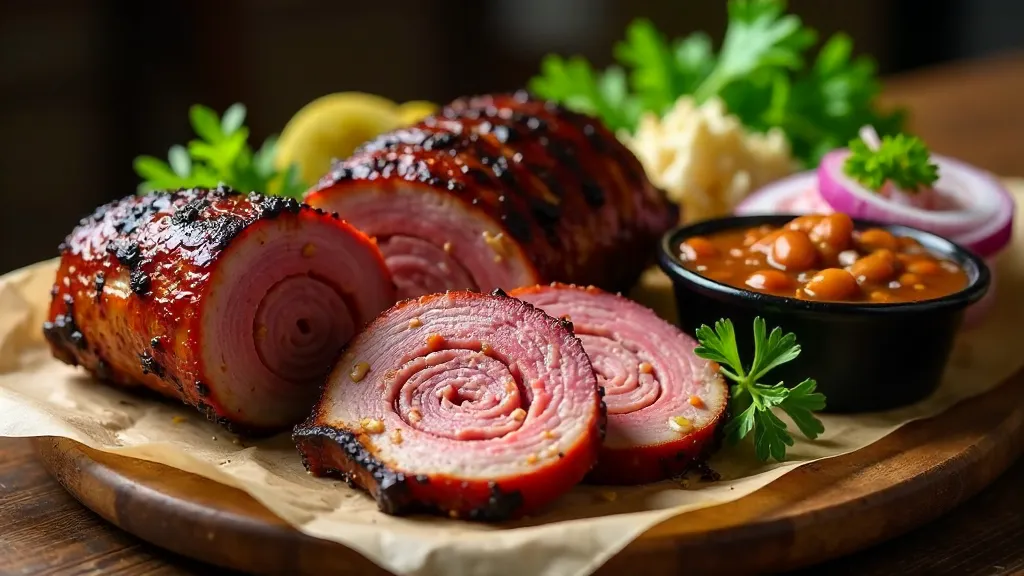
Serve your pork belly sliced, on a sandwich, or however you like to enjoy your southern-style BBQ.
For wine pairing, you would be fine with your favorite, but we recommend a Bandol Rosé, which features the acidity to cut through the fat while the fruit and spice notes serve to enhance the smoky flavor of your meal. If you would prefer a beer, try your Texas Brisket Style Pork Belly with a bitter and hoppy IPA or APA, which will pair beautifully, cutting through the unctuous fat with the hops while the citrus notes play with the black pepper.
Once your pork belly hits that perfect internal temp and has had a good rest, it’s time to slice it and savor the magic. Whether you’re building a sandwich stacked with smoky pork, enjoying it straight-up, or pairing it with a bold IPA or crisp Bandol Rosé, this Texas Brisket Style Pork Belly is sure to steal the show at your next BBQ. Fire up the grill and give this one a try — your taste buds will thank you. Sauce it up or stay plain, this belly is great no matter how you cut it. What is your favorite way to grill up pork belly? Share your porky BBQ recipes, ideas, and photos on our social media pages like Facebook and Instagram, using the hashtags #NapoleonEats and #NapoleonGrill.
Happy Grilling!
** That is one quarter of a percent times the weight of the meat. In this case, 5lb. = 2268g 2268g x 0.25% = 5.6g 2268g x 0.0025 = 5.6g **